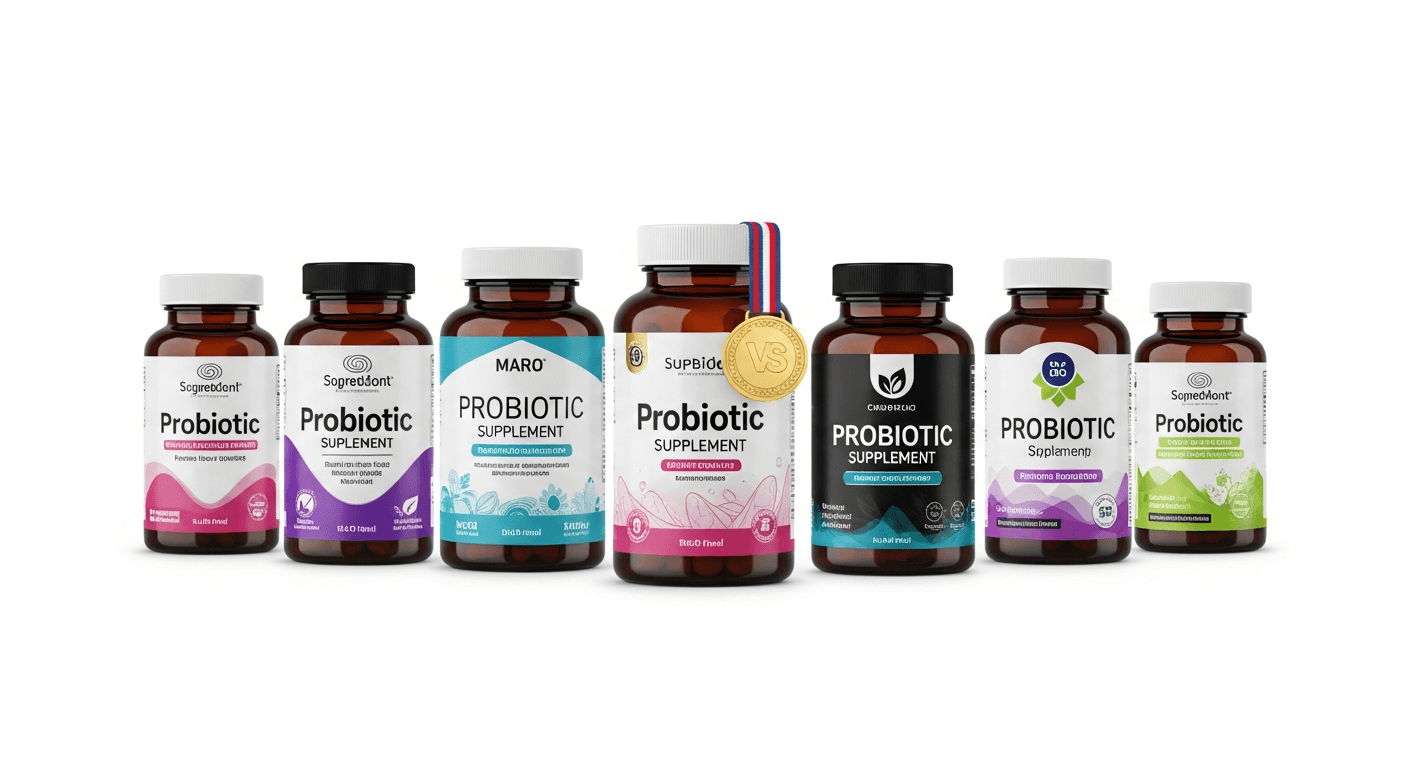
Best Vaginal Probiotics (2026): 6 Products Ranked
We compared 6 popular options on strain evidence, pricing, format, and real-world results. One product stood out. Here is exactly why.

Dr. Grace Holland
OB/GYN, Women's Health Researcher
I get emails every week from women asking whether vaginal probiotics are worth taking. The short answer is: some are, most aren't.
The category is cluttered. Most products lean on marketing language about "vaginal flora" and "pH balance" while using generic strains with no published research for vaginal applications. A few stand out.
I evaluated six of the most-searched products using three criteria: strain-level clinical evidence, price per month, and real-world convenience. Below is what I found.
How We Ranked These
Each product was scored on four categories: ingredient quality (strain evidence and dosing), clinical backing, value for money, and user experience. Ratings are out of 5. Affiliate links are present. They do not influence rankings. Products were evaluated independently using published research.
Quick Comparison
| Product | Rating | Price/mo | Format | Best For |
|---|---|---|---|---|
| Nuora Feminine Balance GummiesPICK | 4.4/5 | $39.99 | Gummy | BV prevention, UTI support |
| Happy V Prebiotic + Probiotic | 3.8/5 | $29.99 | Capsule | Strain diversity on a budget |
| Garden of Life Dr. Formulated | 3.5/5 | $32.99 | Capsule | High-CFU general gut health |
| Love Wellness Good Girl | 3.5/5 | $24.99 | Capsule | Budget-friendly daily probiotic |
| Seed DS-01 Daily Synbiotic | 3.3/5 | $49.99 | Capsule | General gut microbiome support |
| Renew Life Women's Care | 3.2/5 | $22.99 | Capsule | Low-cost capsule option |
Why Most Vaginal Probiotics Fall Flat
Before we get into individual products, this is worth understanding.
The standard Lactobacillus strains used in most probiotics, like L. acidophilus and L. rhamnosus, are fragile. They die in stomach acid at rates of 60 to 90 percent before reaching the gut. Whatever CFU count is printed on the label is not what actually colonizes your microbiome.
Spore-forming strains, like Bacillus coagulans, survive stomach acid at nearly 100 percent. That is why a product with 1 billion CFU of B. coagulans SNZ 1969 can outperform a product claiming 50 billion CFU of generic Lactobacillus in clinical settings.
The second problem is strain specificity. Not every Lactobacillus strain behaves the same way. L. reuteri RC-14 has published evidence for vaginal health. L. rhamnosus GR-1 does too. But L. acidophilus NCFM, a common strain in food-aisle probiotics, has very little research specific to vaginal applications. Strain name matters more than genus.
What to Check on Any Probiotic Label
- Specific strain designation (not just genus and species)
- Published research for that exact strain for vaginal or digestive health
- Delivery mechanism (spore-forming, enteric-coated, or refrigerated)
- Third-party testing for CFU count at time of expiry, not manufacture
Nuora Feminine Balance Gummies
Editor's PickRating: 4.4/5 · $39.99/month · Gummy
Nuora is the only gummy-format vaginal probiotic I've evaluated with genuine strain-level clinical evidence. Most gummies in this category compromise on active ingredients to hit a price point. Nuora did not.
What's Inside
Five active ingredients: Bacillus coagulans SNZ 1969 (1 billion CFU), Bromelain (150mg), Pineapple extract, Vitamin C, and Pectin.
The SNZ 1969 strain has been studied in randomized controlled trials going back to 2004. A 2015 study in the European Journal of Clinical Nutrition showed significant improvements in bloating and abdominal discomfort at exactly the 1 billion CFU dosage Nuora uses. A 2009 BMC Gastroenterology study found improved vaginal pH and reduced pathogenic bacteria in women with BV after oral B. coagulans supplementation.
Bromelain at 150mg is within the therapeutic range for reducing mucosal inflammation. Pineapple extract adds antioxidant support. Vitamin C acidifies the mucosal environment. Pectin acts as a prebiotic to feed the colony.
Key Finding
Bacillus coagulans SNZ 1969 is one of roughly four probiotic strains with peer-reviewed clinical evidence specifically for vaginal health. Most competitors use strains that have never been tested in vaginal health trials. That gap is the core reason Nuora ranks first.
Format and Convenience
Gummy format with a mixed-berry flavor. Two per day. No refrigeration required. The taste is good. No chalky aftertaste. For anyone who avoids capsules, this is the only well-formulated gummy option in the category.
Pricing and Guarantee
$39.99/month on subscription. $49.99 one-time. Premium pricing compared to capsule options. The 60-day money-back guarantee is legitimate and easy to use based on our test. Cancellation takes under two minutes.
Pros
- Clinically studied strain (SNZ 1969) with peer-reviewed trials
- Spore-forming bacteria survives stomach acid near 100%
- Gummy format, no capsules, good taste
- 60-day money-back guarantee
Cons
- Premium pricing at $39.99/month
- Subscription model (auto-renews monthly)
- No third-party batch testing disclosed
The strongest formulation in the category. Strain specificity and delivery mechanism set it apart.
Read our full 30-day Nuora review for detailed testing notes and ingredient deep-dive.
Happy V Prebiotic + Probiotic
Rating: 3.8/5 · $29.99/month · Capsule
Happy V is a solid second option, especially if you want multiple Lactobacillus strains at a lower price point. The formula combines Lactobacillus strains with prebiotic fiber, which feeds beneficial bacteria after they colonize.
What's Inside
A blend of Lactobacillus strains including L. acidophilus, L. rhamnosus, and L. reuteri, paired with inulin-based prebiotic fiber. The strain combination covers multiple mechanisms: competitive exclusion of pathogens, lactic acid production for pH support, and prebiotic nourishment to sustain colonization.
The limitation: Happy V does not disclose the specific strain designations (e.g., L. rhamnosus GR-1 vs. a generic L. rhamnosus). That matters because strain-level evidence is not transferable across designations. General Lactobacillus genus claims are weaker than named-strain clinical trials.
The Prebiotic Advantage
Including prebiotic fiber is a smart formulation choice that most competitors skip. Prebiotics feed the probiotic strains after colonization, improving persistence. The downside is that inulin can cause temporary gas in sensitive individuals during the first one to two weeks.
Pros
- Good strain diversity with multiple Lactobacillus species
- Prebiotic fiber improves colonization persistence
- More affordable than Nuora at $29.99/month
- Capsule format is familiar and widely accepted
Cons
- Specific strain designations not disclosed on label
- Less clinical evidence than Nuora's SNZ 1969 strain
- Capsule format less convenient for some users
- Inulin can cause temporary bloating in sensitive individuals
A good budget-friendly option with solid strain diversity. Transparency around strain designations could be better.
Garden of Life Dr. Formulated Women's Probiotics
Rating: 3.5/5 · $32.99/month · Capsule
Garden of Life is a legacy brand with a lot of brand equity and a 50 billion CFU count that looks impressive on paper. In practice, the formula is designed for general gut health rather than vaginal-specific outcomes.
What's Inside
16 strains at 50 billion CFU. Notable inclusions are L. reuteri and L. fermentum, both of which have some vaginal health research. The formula is otherwise a broad-spectrum gut probiotic.
The refrigeration recommendation is worth noting. Many users receive the product after shipping without temperature control, which can degrade CFU count in fragile Lactobacillus strains. A shelf-stable option is available but may have a different strain profile.
Pros
- High strain diversity with 16 strains
- Established brand with quality manufacturing standards
- Includes L. reuteri and L. fermentum with some vaginal health research
- Shelf-stable option available
Cons
- Not specifically formulated for vaginal health
- High CFU count overstated given Lactobacillus survival rates
- Refrigeration recommended for primary product (shipping risk)
- More expensive than similarly positioned competitors
A quality product for general gut health. Not the right choice if vaginal health is the primary goal.
Love Wellness Good Girl Probiotics
Rating: 3.5/5 · $24.99/month · Capsule
Love Wellness has built strong brand recognition in the women's wellness space. Good Girl Probiotics is their flagship probiotic and it's priced accessibly. The formula is straightforward but limited.
What's Inside
8 strains at 10 billion CFU, including L. acidophilus and several other standard Lactobacillus species. The formulation targets vaginal health in its marketing but does not use the specific named strains (like RC-14 or GR-1) that have the strongest clinical track record.
At 10 billion CFU with generic Lactobacillus strains and 60 to 90 percent die-off in stomach acid, the actual delivery to the microbiome is modest. This is fine for general maintenance but probably not enough for active vaginal health concerns.
Pros
- Affordable at $24.99/month
- Strong brand credibility in women's wellness
- Targeted marketing toward vaginal health
- Includes L. acidophilus for basic Lactobacillus support
Cons
- Lower CFU count (10B) with no spore-forming strains
- Generic strain designations, limited published research
- Standard capsule format with no delivery enhancement
- Formulation has not been independently validated for vaginal health
Good entry-level option at a fair price. Limited by generic strain choices and low CFU count.
Seed DS-01 Daily Synbiotic
Rating: 3.3/5 · $49.99/month · Capsule-in-capsule
Seed is the most expensive product on this list and one of the most technically sophisticated. The capsule-in-capsule design protects probiotic strains through the stomach and into the colon. The problem is that Seed is designed for general gut health, not vaginal health specifically.
What's Inside
24 probiotic strains at 53.6 billion AFU (Active Fluorescent Units). The outer capsule contains prebiotic fiber derived from Indian pomegranate. The inner capsule delivers the probiotic blend to the colon via an acid-resistant shell.
Seed has published research on many of its individual strains, and their science team is legitimate. But none of the published trials are specific to vaginal health outcomes. Seed positions this as a general wellness product, not a vaginal probiotic. If vaginal health is the goal, that matters.
Pros
- Innovative capsule-in-capsule delivery system protects strains
- 24 strains with extensive individual strain research
- 53.6 billion AFU with verified delivery to the colon
- Strong science team and published research program
Cons
- Most expensive option at $49.99/month
- Not specifically a vaginal probiotic
- General wellness positioning, not women's health focus
- No published trials for vaginal health outcomes
Technically impressive but the wrong tool for the job. Worth considering only if you want a general synbiotic alongside a vaginal-specific probiotic.
Renew Life Women's Care Probiotic
Rating: 3.2/5 · $22.99/month · Capsule
Renew Life is the most affordable option here. It does the job for basic probiotic supplementation but has the weakest vaginal-specific evidence of any product on this list.
What's Inside
12 strains at 25 billion CFU with delayed-release capsule technology. The delayed-release mechanism improves gut survival compared to standard capsules, which is a legitimate advantage. The strain list is generic, with no named-strain clinical trials for vaginal health applications.
Pros
- Most affordable option at $22.99/month
- Delayed-release capsule improves gut delivery
- 12 strains with solid Lactobacillus representation
- Widely available in stores and online
Cons
- Generic strain formulation with no vaginal health research
- Delayed-release helps, but still fragile Lactobacillus strains
- No differentiation from standard pharmacy probiotics
- Limited evidence for any women's health benefit beyond general gut support
Decent for general gut health at the lowest price. Not a meaningful vaginal probiotic.
How to Pick the Right One for You
The decision comes down to two questions: what is your primary goal, and what is your budget?
You want BV prevention or pH support
Start with Nuora. The SNZ 1969 strain has the strongest published evidence for vaginal pH improvement of any product on this list. If the price is too high, Happy V is the next best option.
You primarily want digestive support
Nuora doubles well here too (Bacillus coagulans has the strongest bloating and IBS research). Garden of Life is also solid for pure gut health.
You hate swallowing capsules
Nuora is the only well-formulated gummy in this category. There is no comparable gummy alternative with similar strain evidence.
Budget is tight
Love Wellness at $24.99/month or Renew Life at $22.99/month. Both are acceptable general probiotics. Neither is specifically validated for vaginal health, but both offer some Lactobacillus support.
What to Actually Expect
Probiotics are not a fast fix. Microbiome changes take time.
Most women notice digestive changes (less bloating, more regularity) within two to three weeks. Vaginal health changes, if any, typically follow at the three to six week mark as gut colonization starts affecting downstream pH and flora composition.
If you have an active BV infection, a probiotic is not the right first step. Antibiotics treat the infection. Probiotics help prevent recurrence after treatment. That is a meaningful distinction. See a provider.
Final Verdict
If I had to recommend one product to a friend asking about vaginal probiotics, it would be Nuora Feminine Balance Gummies.
The price is higher than competitors. But the clinical evidence behind the core strain (SNZ 1969) is stronger than anything else on this list, the spore-forming delivery mechanism actually works, and the gummy format removes the compliance barrier that kills most supplement habits.
Happy V is the best alternative if you want a capsule at a lower price. Garden of Life works well for general gut health. Love Wellness is the best budget capsule option. Seed is technically impressive but not the right tool for vaginal health. Renew Life is fine for general gut maintenance.
Bottom Line
Nuora wins on clinical evidence and formulation quality. Happy V is the strongest budget alternative. Avoid products that lead with CFU count without disclosing specific strain designations. High CFU numbers with fragile strains and no strain-specific research are mostly marketing.
Frequently Asked Questions
What is the best vaginal probiotic in 2026?
Nuora Feminine Balance Gummies ranks first in our evaluation based on strain-level clinical evidence and delivery mechanism. It uses Bacillus coagulans SNZ 1969, one of the few probiotic strains with published randomized controlled trials for vaginal health outcomes.
Do vaginal probiotics actually work?
Some do. The key is strain specificity. Products using named strains with published vaginal health research (SNZ 1969, RC-14, GR-1) have evidence behind them. Generic multi-strain blends with no strain-level data are unlikely to produce meaningful vaginal health outcomes.
Can probiotics help with BV?
Yes, for prevention and recurrence reduction. Probiotics are not a treatment for active BV. They support the vaginal microbiome after antibiotic treatment to reduce recurrence rates. A 2009 BMC Gastroenterology study showed that oral B. coagulans supplementation improved vaginal pH and reduced pathogenic bacteria in women with BV.
Is a higher CFU count better for vaginal probiotics?
No. Spore-forming strains like Bacillus coagulans survive stomach acid at near 100 percent efficiency. Fragile Lactobacillus strains lose 60 to 90 percent viability before reaching the gut. 1 billion CFU of B. coagulans SNZ 1969 delivers more active organisms than 50 billion CFU of a generic Lactobacillus blend.
Methodology and Disclosures
Products were evaluated using published peer-reviewed research, manufacturer label information, and independent pricing data from brand websites and major retailers as of February 2026. No products were provided by manufacturers for this review. Clinical research cited was sourced from PubMed and peer-reviewed journals.
This page contains affiliate links. If you purchase through these links, we may receive a commission at no additional cost to you. Affiliate relationships were established after initial evaluation and do not influence product rankings.
Medical Disclaimer: This article is for informational purposes only and does not constitute medical advice. These statements have not been evaluated by the FDA. No product mentioned is intended to diagnose, treat, cure, or prevent any disease. Consult a qualified healthcare provider before starting any supplement, especially if pregnant, nursing, or taking prescription medication.